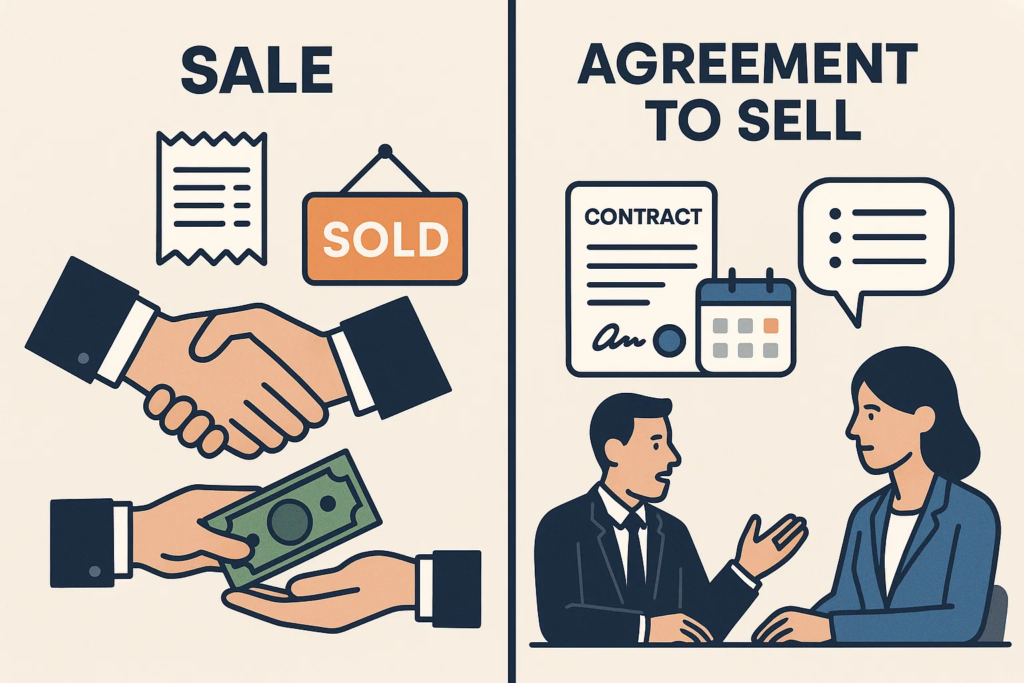
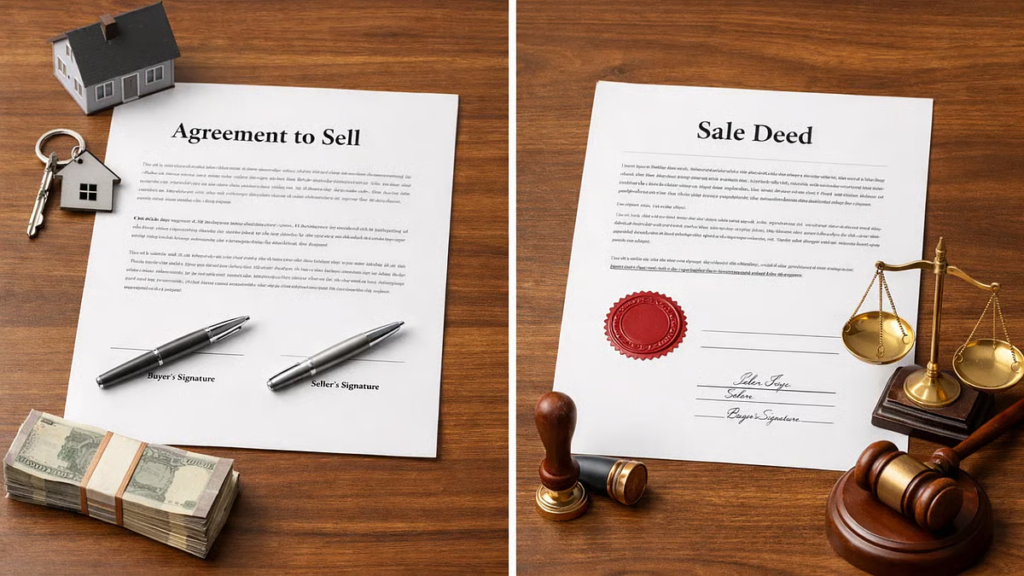
An Agreement to Sale plays a crucial role in property transactions in India. Many buyers and sellers mistakenly believe that rights arise only after execution of the final sale deed. In reality, an agreement to sale itself creates strong and enforceable legal rights for both parties.
This guide explains what an Agreement to Sale is, buyer and seller rights, and legal remedies available in case of breach, in a simple question-and-answer format.
What Is an Agreement to Sale?
An Agreement to Sale is a legal contract in which:
- The seller agrees to sell a property
- The buyer agrees to purchase the property
- Both parties agree on terms and conditions
Key Details Included in an Agreement to Sale:
- Sale consideration (price)
- Advance or earnest money paid
- Timeline for payment and execution of sale deed
- Possession date
- Rights and obligations of both parties
Important:
Even before the final sale deed is executed, a valid agreement to sale is legally enforceable in court.
Also Read: Real Estate Reality in Tricity: Homebuyers Trapped Between False Promises and Endless Litigation
Buyer Rights If the Seller Refuses to Sell the Property
If a seller backs out or refuses to execute the final sale deed, the buyer has strong legal remedies.
Legal Options Available to the Buyer:
1. Specific Performance of Contract
The buyer can approach the civil court and request the court to direct the seller to complete the sale as agreed.
2. Claim for Damages
The buyer may seek monetary compensation for losses caused due to breach of contract.
3. Rescission of Contract
The buyer can cancel the agreement and demand:
- Refund of advance money
- Interest on the refunded amount
The choice of remedy depends on facts, intention of parties, and buyer readiness to perform their part.
Seller Rights If the Buyer Refuses to Purchase
The law protects sellers as well, provided the seller has complied with their obligations.
Remedies Available to the Seller:
- File a civil suit for specific performance
- Claim compensation for breach of contract
- Forfeit earnest money if the agreement permits, subject to court scrutiny
Courts closely examine whether forfeiture is reasonable and justified.
What Is “Specific Performance of Contract”?
Specific Performance is a legal remedy where the court orders a party to perform their contractual obligations, instead of merely paying damages.
Key Points About Specific Performance:
- Commonly used in property disputes
- Available under the Specific Relief Act, 1963
- Especially relevant when property is unique
When Courts May Refuse Specific Performance:
- Contract terms are vague or illegal
- Plaintiff has not fulfilled their obligations
- Enforcement causes undue hardship
- Contract performance is impossible
Readiness and willingness of the party seeking relief is a critical requirement.
How Can a Buyer Protect Their Rights Under an Agreement to Sale?
Buyers must take proactive steps to avoid disputes and strengthen their legal position.
Best Practices for Buyers:
- Execute a registered Agreement to Sale
- Clearly define timelines for payment and possession
- Include penalty and interest clauses for delay
- Preserve proof of payments and written communication
- Take immediate legal action if the seller defaults
Delay in approaching the court can weaken the buyer’s case.
Common Mistakes Buyers and Sellers Should Avoid
- Relying on unregistered or oral agreements
- Ignoring breach in early stages
- Not documenting payments properly
- Assuming advance money is non-refundable without legal review
In property transactions, documentation and timing decide outcomes.
Key Takeaways: Agreement to Sale & Legal Rights
- An Agreement to Sale is a binding legal contract
- Both buyers and sellers have enforceable rights
- Breach by either party can be challenged in civil court
- Specific performance is the most powerful remedy in property disputes
Conclusion
An Agreement to Sale is not a mere formality—it is the foundation of property rights and obligations. Whether you are a buyer or a seller, understanding your legal remedies can save years of litigation and financial loss.
Timely legal action and proper documentation are the strongest protections in property transactions.
FAQs
1. Is an Agreement to Sale legally binding in India?
Yes, an Agreement to Sale is a legally binding contract. Even before the final sale deed is executed, both the buyer and the seller can enforce their rights through a civil court.
2. What can a buyer do if the seller refuses to execute the sale deed?
If the seller refuses, the buyer can file a civil suit seeking specific performance of the contract, claim damages, or cancel the agreement and seek refund of advance money with interest.
3. Can a seller cancel an Agreement to Sale if the buyer defaults?
Yes, if the buyer fails to fulfill their obligations, the seller may approach the court for specific performance, claim compensation, or forfeit earnest money if allowed under the agreement and approved by the court.
4. What is specific performance in property disputes?
Specific performance is a legal remedy where the court orders the defaulting party to perform the contract, such as completing the property sale, instead of merely paying monetary compensation.
5. Is registration of Agreement to Sale mandatory?
While an unregistered agreement may still have evidentiary value, a registered Agreement to Sale provides stronger legal protection and is highly recommended to avoid disputes and denial of rights.